Address
Office Space Podomoro City Deli Medan, Medan City, North Sumatra, 20111
Work Hours (Office)
Monday to Friday: 8AM - 3PM
Address
Office Space Podomoro City Deli Medan, Medan City, North Sumatra, 20111
Work Hours (Office)
Monday to Friday: 8AM - 3PM
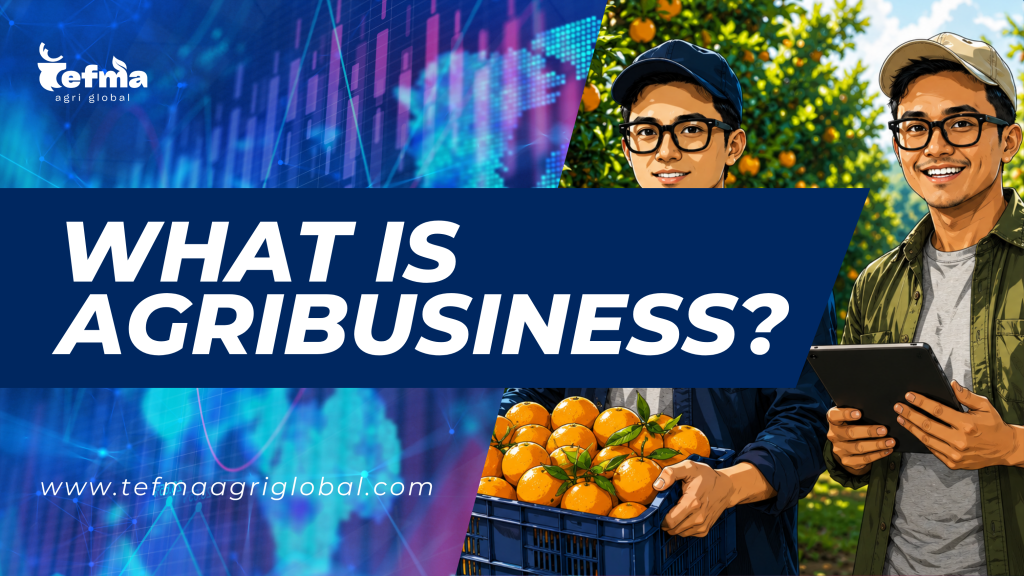
In general, agribusiness refers to all economic activities related to the production, processing, distribution, marketing, and management of agricultural products, including all supporting industries and services connected to agriculture.
The term “agribusiness” was first popularized by John H. Davis and Ray A. Goldberg from Harvard Business School in 1957 through their influential work A Concept of Agribusiness. They defined agribusiness as the entire spectrum of operations involved in manufacturing and distributing agricultural inputs, farming production activities, and the storage, processing, and distribution of agricultural commodities to consumers.
In other words, agribusiness is not limited to farming activities in the field. It also includes:
In the modern context, agribusiness represents the integration of agriculture and business into a comprehensive economic system based on biological resources.
Agribusiness holds a vital position in human civilization because it is directly connected to one of humanity’s most basic needs: food.
According to data from the Food and Agriculture Organization (FAO), the global population is projected to exceed 9.7 billion people by 2050. This growth significantly increases global food demand.
At the same time, the world faces major challenges such as:
As a result, modern agribusiness has become one of the most important sectors for maintaining food security and long-term economic sustainability.
Many developed countries position agribusiness as a strategic national industry. The Netherlands, for example, despite its relatively small territory, has become one of the world’s largest agricultural exporters through advanced agricultural technologies developed by Wageningen University & Research.
The United States, through institutions such as UC Davis, Purdue University, Texas A&M University, Iowa State University, and Cornell University, has become a global innovation hub for precision agriculture, biotechnology, agricultural economics, and sustainable farming systems.
In Asia, China Agricultural University plays a critical role in developing smart agriculture and strengthening China’s national food security. Meanwhile, in Indonesia, IPB University remains one of the leading institutions in tropical agriculture and agribusiness studies.
Agribusiness encompasses a broad and highly complex system. In modern academic literature, agribusiness systems are generally divided into several major subsystems.
This subsystem includes all industries and services providing agricultural production inputs such as:
Technological advancement has transformed the agricultural input sector dramatically. Today, many agritech companies utilize AI, the Internet of Things (IoT), machine learning, and data analytics to improve agricultural efficiency and productivity.
This subsystem represents the core cultivation activities carried out by farmers, agribusiness corporations, and agricultural enterprises.
Agricultural production includes:
In the modern era, agricultural production is no longer dependent solely on traditional experience. It increasingly relies on scientific agriculture supported by technology and data-driven decision-making.
Agricultural commodities are generally perishable and require post-harvest processing. Therefore, agroindustry has become a crucial component of agribusiness.
Examples include:
In many cases, the highest value-added activities in modern agribusiness originate from this processing sector.
Modern agribusiness depends heavily on efficient supply chain and distribution systems.
This subsystem includes:
In the contemporary economy, agribusiness success is determined not only by production capacity but also by the ability to manage supply chains efficiently and sustainably.
Agribusiness systems also require support from numerous related sectors such as:
Without strong supporting institutions, sustainable agribusiness development becomes extremely difficult.
Twenty-first century agribusiness differs significantly from conventional agricultural systems.
Modern agribusiness is characterized by technological integration, global interconnectedness, market orientation, data-driven operations, sustainability principles, and strong reliance on innovation.
Concepts such as smart farming, climate-smart agriculture, precision agriculture, regenerative agriculture, and sustainable food systems have become central focuses in global agricultural research.
Institutions such as ETH Zurich, the University of Queensland, the University of Reading, and the Norwegian University of Life Sciences actively conduct research related to sustainable agriculture and global food system resilience.
Technology has become one of the most influential forces transforming modern agribusiness.
Today, farmers and agribusiness corporations increasingly utilize:
These technologies help improve productivity, operational efficiency, product quality, and environmental sustainability.
Artificial intelligence is now being applied to:
According to multiple global research reports, the agritech market is expected to continue growing significantly over the coming decades due to increasing food demand and the global need for efficient agricultural production systems.
Food security has become one of the most critical global issues of the modern era.
Climate change has increased the risk of crop failures, water shortages, and declining land productivity in many regions around the world. Consequently, modern agribusiness must focus not only on profitability but also on the sustainability of the global food system.
Organizations such as the FAO, World Bank, and numerous international research institutions continuously emphasize the importance of investing in sustainable agribusiness to maintain long-term food stability.
The concept of sustainable agribusiness has emerged as a dominant approach in global agricultural development. This approach seeks to balance economic productivity, environmental sustainability, and social welfare.
Indonesia possesses enormous agribusiness potential due to its:
Indonesia’s major agricultural commodities include:
In addition, the rise of the digital economy has created new opportunities for younger generations to enter the agribusiness sector through:
In recent years, many global investors have begun recognizing Indonesia’s agribusiness sector as one of the world’s most promising emerging markets.
Despite its enormous potential, agribusiness faces highly complex challenges.
Some of the major issues include:
Additionally, modern agribusiness faces increasing pressure regarding environmental concerns such as deforestation, carbon emissions, and excessive natural resource exploitation.
Therefore, the future of agribusiness depends heavily on humanity’s ability to develop agricultural systems that are both productive and environmentally sustainable.
The future of agribusiness will be shaped significantly by technology, sustainability, and digital transformation.
Emerging concepts such as:
are expected to become integral parts of future global food systems.
Many economic analysts predict that agribusiness will become one of the most strategic industries of the twenty-first century because the world urgently needs food systems that are more efficient, resilient, sustainable, and technologically advanced.
In the modern era, agribusiness is no longer viewed as a purely traditional sector associated with manual labor and conventional farming practices. Agribusiness has evolved into a multidisciplinary industry combining agriculture, economics, business, engineering, environmental science, data science, biotechnology, and sustainability management.
Agribusiness is an integrated economic system encompassing all activities related to agricultural inputs, production, processing, distribution, marketing, and supporting services.
In today’s rapidly changing world, agribusiness plays a strategic role in ensuring food security, economic growth, social stability, and environmental sustainability.
Technological developments such as artificial intelligence, the Internet of Things, precision agriculture, and digital farming are transforming agribusiness into a modern innovation-driven industry.
For many nations, agribusiness is no longer simply an economic sector. It is a foundational pillar for the future of global civilization.
As food demand continues to increase amid climate change and global transformation, understanding agribusiness has become increasingly important for academics, governments, entrepreneurs, investors, and society as a whole.
Modern agribusiness is not merely about farming. It is about how humanity builds sustainable food systems, economic resilience, and a better future for generations to come.