Address
Office Space Podomoro City Deli Medan, Medan City, North Sumatra, 20111
Work Hours (Office)
Monday to Friday: 8AM - 3PM
Address
Office Space Podomoro City Deli Medan, Medan City, North Sumatra, 20111
Work Hours (Office)
Monday to Friday: 8AM - 3PM
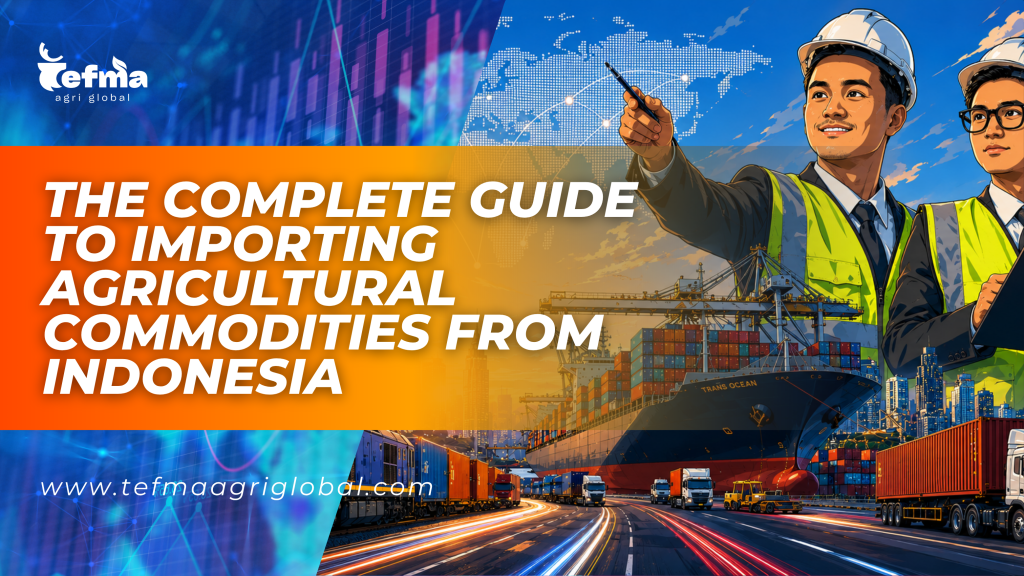
Indonesia has established itself as one of the world’s most significant agricultural sourcing destinations, supplying a diverse range of commodities to international markets across Asia, Europe, the Middle East, Africa, and the Americas.
As the largest economy in Southeast Asia and one of the world’s most biodiverse nations, Indonesia offers an extensive portfolio of agricultural products supported by vast cultivation areas, favorable tropical growing conditions, multiple harvest cycles, and an increasingly sophisticated export ecosystem.
From coffee and cocoa to spices, coconut products, cassava derivatives, nuts, herbs, botanicals, and processed agricultural ingredients, Indonesia continues to play a critical role in global agricultural supply chains.
However, successful importing requires considerably more than identifying a supplier and negotiating a price. International buyers must evaluate supplier credibility, verify product quality, understand export documentation requirements, manage logistics risks, ensure regulatory compliance, and establish long-term supply chain resilience.
This guide provides a comprehensive overview of the key considerations, procedures, risks, and best practices involved in importing agricultural commodities from Indonesia in 2026 and beyond.
Indonesia is among the world’s leading producers and exporters of numerous agricultural commodities, including:
Its diverse geography, spanning thousands of islands and multiple climatic zones, supports a broad range of crop production throughout the year.
Indonesia’s tropical climate allows many commodities to be cultivated continuously across different regions.
Depending on the commodity, production cycles may occur multiple times annually, providing buyers with greater sourcing flexibility and helping reduce dependence on a single harvest season.
Many international buyers source from Indonesia because of its combination of:
Pricing competitiveness varies by commodity, specification, seasonality, and market conditions, making proper market benchmarking essential.
Indonesia continues to invest heavily in:
These improvements contribute to increasing efficiency across the export process and support Indonesia’s growing role in international trade.
A clear understanding of the supply chain is essential when assessing suppliers and managing procurement risk.
A substantial portion of Indonesian agricultural production originates from smallholder farmers operating across multiple regions.
Many commodities are consolidated through farmer associations, cooperatives, and producer organizations that help coordinate production and quality management.
Collectors purchase commodities from multiple farming communities and consolidate volumes suitable for commercial transactions.
Processors may perform:
Exporters typically coordinate:
Understanding where a supplier operates within the supply chain helps buyers evaluate traceability, operational control, and supply reliability.
Thorough supplier verification should be completed before entering into any commercial agreement.
Buyers should request and verify:
Assess:
Review:
Professional procurement teams increasingly conduct:
These procedures help reduce financial, legal, and reputational risks.
Whenever practical, buyers should perform:
Verification should always precede financial commitment.
A supplier may be legitimate but still lack the operational capacity to fulfill large or recurring orders.
Buyers should evaluate:
Capacity assessment is particularly important for long-term contracts and annual procurement programs.
A significant percentage of international trade disputes result from poorly defined product specifications.
Every purchase agreement should clearly define:
Examples include:
Moisture specifications directly impact:
Contracts should specify acceptable limits for:
Define maximum allowable levels for:
Specify:
Detailed specifications significantly reduce the likelihood of disputes.
Successful sourcing programs typically begin with a structured sampling process.
Used to determine basic product suitability.
Used for laboratory testing and technical review.
Represent the product intended for export.
Reference samples retained by both buyer and seller for future dispute resolution.
Approved samples should form part of the contractual quality reference framework.
Independent testing often plays a critical role in agricultural commodity transactions.
Common analyses include:
Testing methodologies should be agreed upon before shipment and incorporated into purchase contracts.
Whenever possible, testing should be performed by accredited laboratories.
Global markets increasingly require supply chain transparency.
Modern sourcing programs often require:
Many buyers prioritize suppliers participating in:
Depending on the product and destination market, buyers may require:
Certification requirements vary significantly across industries and jurisdictions.
Agricultural commodity pricing is influenced by multiple factors.
Prices may fluctuate due to:
Market demand shifts can significantly influence pricing levels.
Exchange rate movements involving:
can affect sourcing costs and profitability.
Ocean freight and inland transportation expenses may materially impact landed cost calculations.
Higher grades generally command premium pricing.
Importers should benchmark quotations against prevailing market conditions rather than relying solely on supplier offers.
Agricultural imports are subject to varying regulatory requirements depending on the destination market.
Many agricultural products require phytosanitary certification demonstrating compliance with importing-country regulations.
Importers should verify compliance with all applicable food safety standards and legal requirements.
Requirements often differ significantly across:
Importers should always verify current regulations before shipment.
Common export documents include:
Documentation requirements vary depending on commodity type and destination country.
Indonesia participates in multiple bilateral and multilateral trade agreements.
Eligible products may benefit from:
Importers should verify eligibility requirements and applicable Certificates of Origin before shipment.
Key seaports include:
The Four Main Ports of Indonesia
Major international airports include:
Depending on commodity requirements:
may be used.
Comprehensive cargo insurance should be strongly considered for all international shipments.
Incoterms define the allocation of costs, responsibilities, and risks between buyers and sellers.
Commonly used terms include:
The selected Incoterm should always be clearly specified in contracts and shipping documentation.
Common payment mechanisms include:
Provides structured banking protection for both parties.
Often used in established commercial relationships.
Widely used in global commodity transactions.
Typical structures may include:
The appropriate payment structure should reflect transaction value, risk profile, and relationship maturity.
Independent inspection services may include:
Third-party inspections provide additional assurance and objective verification before shipment.
Importers should proactively manage:
Agricultural products naturally vary between harvests.
Improper drying may affect quality and shelf life.
Documentation discrepancies can lead to customs delays.
Commodity prices may fluctuate rapidly.
Import and export regulations may evolve without significant notice.
Potential causes include:
Agricultural supply chains are particularly exposed to force majeure risks.
Examples include:
Contracts should clearly define force majeure events, notification requirements, and mitigation responsibilities.
Well-structured contracts should address:
Strong contractual frameworks significantly reduce commercial risk.
Common fraud risks include:
Before releasing funds:
✓ Verify legal registration
✓ Confirm beneficial ownership
✓ Conduct video meetings
✓ Verify facilities
✓ Check references
✓ Validate banking details
✓ Perform inspections
✓ Use secure payment structures
Several trends are expected to influence agricultural trade in the coming years:
Companies that adapt to these developments will be better positioned for long-term competitiveness.
Indonesia remains one of the world’s most important agricultural sourcing destinations, offering extensive commodity diversity, favorable production conditions, growing export infrastructure, and increasing integration into global trade networks.
However, successful importing requires far more than securing a supplier and negotiating a price. Importers must combine supplier due diligence, quality assurance, regulatory compliance, logistics planning, financial risk management, contractual protection, and long-term supply chain development.
Organizations that prioritize transparency, traceability, verification, and professional execution throughout the sourcing process are significantly more likely to achieve sustainable, profitable, and resilient sourcing relationships with Indonesian exporters.
Ultimately, successful international trade is built not only on product availability and pricing, but also on trust, compliance, accountability, and operational excellence across the entire supply chain.