Address
Office Space Podomoro City Deli Medan, Medan City, North Sumatra, 20111
Work Hours (Office)
Monday to Friday: 8AM - 3PM
Address
Office Space Podomoro City Deli Medan, Medan City, North Sumatra, 20111
Work Hours (Office)
Monday to Friday: 8AM - 3PM
The world is changing.
Global supply chains are under pressure.
Climate change is affecting harvests across continents.
Geopolitical tensions are disrupting trade routes.
Food security has become a national priority for many countries.
Manufacturers, importers, distributors, and investors are all asking the same question:
Where will the world’s most reliable agricultural resources come from in the decades ahead?
Increasingly, the answer points to one country.
Indonesia.
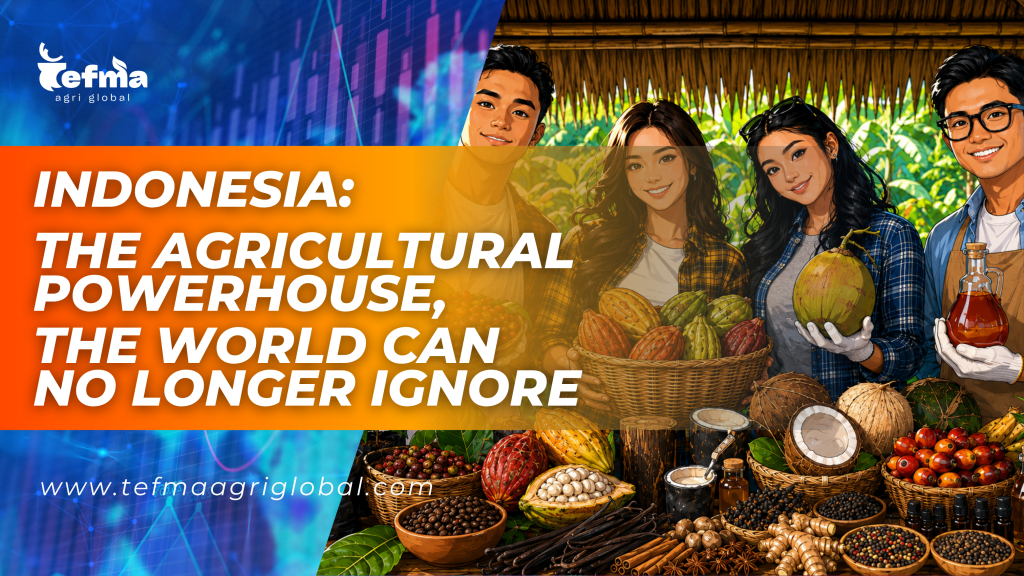
Home to extraordinary biodiversity, fertile volcanic landscapes, abundant rainfall, year-round growing conditions, and one of the largest agricultural workforces in the world, Indonesia stands among the most resource-rich agricultural nations on Earth.
Yet Indonesia’s true value extends far beyond its natural resources.
Indonesia represents something every serious buyer seeks: Long-term opportunity.
For companies looking to build resilient supply chains, secure premium agricultural products, and establish strategic sourcing partnerships, Indonesia is not simply an option.
It is a competitive advantage.
Few countries possess the natural advantages Indonesia enjoys.
Located directly on the equator and spanning more than 17,000 islands, Indonesia benefits from conditions that agricultural producers in many parts of the world can only hope to replicate:
Unlike countries that face short growing seasons and harsh winters, Indonesian agriculture operates throughout the year.
This creates an important advantage for international buyers:
Production continuity.
Reliable production means reliable supply.
Reliable supply means stronger businesses.
Many countries are known for producing one or two major commodities.
Indonesia is different.
Indonesia’s agricultural landscape supports an extraordinary range of products, including:
This diversity allows international buyers to source multiple products from a single country while reducing dependency on fragmented supplier networks.
For global businesses, diversification is no longer a luxury.
It is a necessity.
Indonesia provides it at scale.
Centuries before globalization became a common term, traders crossed oceans to reach the Indonesian archipelago.
The reason was simple.
Indonesia possessed products the world could not find elsewhere.
Nutmeg, Cloves, Pepper.
Exotic spices that transformed international trade and shaped world history.
Today, Indonesia remains one of the world’s most important producers of high-value spices and agricultural commodities.
The same natural conditions that made Indonesia valuable centuries ago continue to create opportunities today.
The difference is that modern buyers can now access these resources through organized supply chains, advanced logistics networks, and international export systems.
The opportunity remains.
Only the scale has grown.
The next generation of agriculture will not be built solely on land and labor.
It will be built on biological resources.
Future industries depend on:
All of these sectors require access to biological diversity.
Indonesia is recognized as one of the world’s megabiodiversity countries.
Its ecosystems contain thousands of plant species, agricultural genetic resources, medicinal plants, tropical fruits, and biological materials with significant scientific and commercial value.
In an era where innovation increasingly begins with biology, Indonesia’s biodiversity is not merely an environmental asset.
It is an economic asset. It is a strategic asset.
And it is one of the country’s greatest long-term advantages.
Geography matters.
Indonesia sits at the crossroads of some of the world’s most important maritime trade routes.
Its location provides strategic access to:
As global demand for agricultural products continues to rise, Indonesia’s geographic position strengthens its role as a key sourcing destination for international markets.
For buyers, shorter and more efficient trade routes often translate into greater supply chain flexibility and improved market responsiveness.
Today’s consumers care about more than price.
They want transparency.
They want traceability.
They want responsible sourcing.
Global brands increasingly seek agricultural products that can demonstrate:
Indonesia’s agricultural sector is evolving to meet these expectations.
Across the country, farmers, cooperatives, exporters, researchers, and private enterprises are investing in better production systems, quality control, certification programs, and sustainability initiatives.
The result is a growing ecosystem capable of supporting international buyers who demand both quality and accountability.
The strongest sourcing strategies are not built around the lowest price.
They are built around long-term reliability.
Forward-thinking companies understand that future success depends on securing dependable access to agricultural resources before market pressures intensify.
Indonesia offers:
✓ Large production capacity
✓ Diverse agricultural resources
✓ Year-round cultivation
✓ Strategic geographic positioning
✓ Expanding infrastructure
✓ Growing export capabilities
✓ Access to unique and premium products
✓ Long-term development potential
These advantages make Indonesia increasingly attractive to manufacturers, food companies, ingredient processors, wholesalers, distributors, and investors worldwide.
Indonesia’s agricultural potential is enormous.
However, successful international trade requires more than access to products.
It requires trust.
It requires execution.
It requires a partner who understands both local production realities and global market expectations.
That is where we create value.
Our role is to connect international buyers with Indonesia’s agricultural strengths through reliable sourcing, transparent communication, quality assurance, and professional export management.
We work to bridge the gap between local production and international demand.
Our mission is simple:
To help global buyers access the best of Indonesia through partnerships built on professionalism, consistency, and long-term mutual growth.
We do not view ourselves merely as exporters.
We view ourselves as strategic sourcing partners.
Our success is measured by the success of our clients.
When our partners grow, we grow together.
The world will need more food.
More natural ingredients.
More sustainable agricultural products.
More resilient supply chains.
More trusted sourcing partners.
The countries capable of meeting these needs will shape the future of global agriculture.
Indonesia is uniquely positioned to be one of them.
For buyers, investors, and companies seeking long-term opportunities, the question is no longer whether Indonesia matters.
The question is:
How soon do you want to secure your position in one of the world’s most promising agricultural markets?
The future of agriculture is being written today.
Indonesia is ready.
And we are ready to build that future with you.